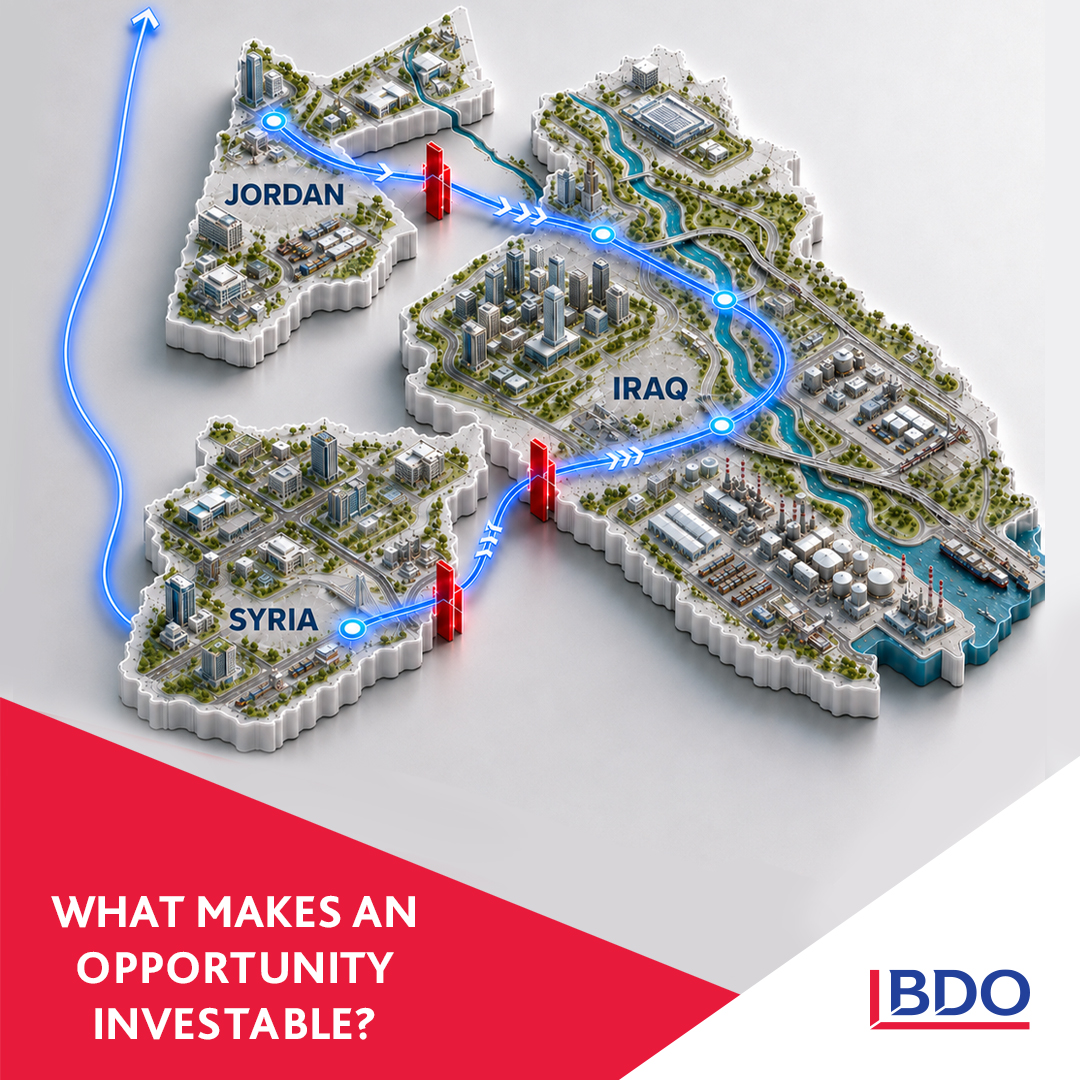
What Makes an Opportunity Investable?
What Makes an Opportunity Investable?
Reading Investment Opportunity Across Jordan, Iraq and Syria
By: Rami SammanManaging Partner
BDO Jordan, Iraq & Syria
The first edition of BDO Insights – Jordan | Iraq | Syria examines three markets with very different operating conditions.
That distinction is important.
Jordan is moving through reform and implementation. Iraq offers scale and significant investment potential, but execution quality remains critical. Syria presents a recovery environment where market need is substantial, but investability will depend on how institutions, financing, supply chains and productive capacity evolve.
From an investor’s perspective, these are not three versions of the same opportunity.
They require different assumptions, different risk tolerances and different entry strategies.
The question is therefore not simply whether an opportunity exists.
The more important question is:
What makes the opportunity investable?
In practice, I would look at a limited number of fundamentals.
First, demand.
Is there real, sustainable demand, or only a visible market need?
Second, cash generation.
How will the business generate cash, and how resilient is that cash flow under different scenarios?
Third, execution capacity.
Can the project or business actually be delivered within the expected timeframe, cost and operating environment?
Fourth, governance.
Who controls key decisions, how is capital protected, and how quickly can management identify and respond to problems?
Fifth, counterparties.
Who are the local partners, customers, suppliers and institutions on which the investment depends?
Sixth, downside.
What happens if assumptions on timing, cost, regulation, financing or demand prove wrong?
These questions apply everywhere, but their weight changes by market.
In Jordan, the key issue is often whether reform translates into practical implementation and whether the regulatory and operating environment supports the investment case as expected.
In Iraq, market size and sector opportunity can be compelling, but the quality of governance, local partnerships, project preparation and execution can determine whether value is actually realized.
In Syria, the distinction between economic need and investable demand is particularly important. Recovery can create major long-term opportunities, but capital will need to follow the rebuilding of institutions, payment mechanisms, supply chains, operating capacity and market confidence.
This is one of the reasons we launched BDO Insights.
The objective is not to repeat market information that is already available.
It is to examine developments through a practical business lens and ask what they mean for investors, management teams and institutions operating in these markets.
Good investment decisions rarely depend on one factor.
A strong financial model can still fail if execution is weak.
Demand can exist while payment capacity remains limited.
A capable local partner can still operate within a poor governance structure.
A sound strategy can still be undermined by unrealistic timing or financing assumptions.
For that reason, I believe the quality of an investment decision depends on how well these factors are assessed together.
At BDO, our role is to support that assessment with financial, regulatory, operational, governance and market analysis, and to distinguish between what is attractive in principle and what is viable in practice.
That distinction matters.
Because an opportunity only becomes relevant to an investor when it is supported by a credible path to execution and value creation.